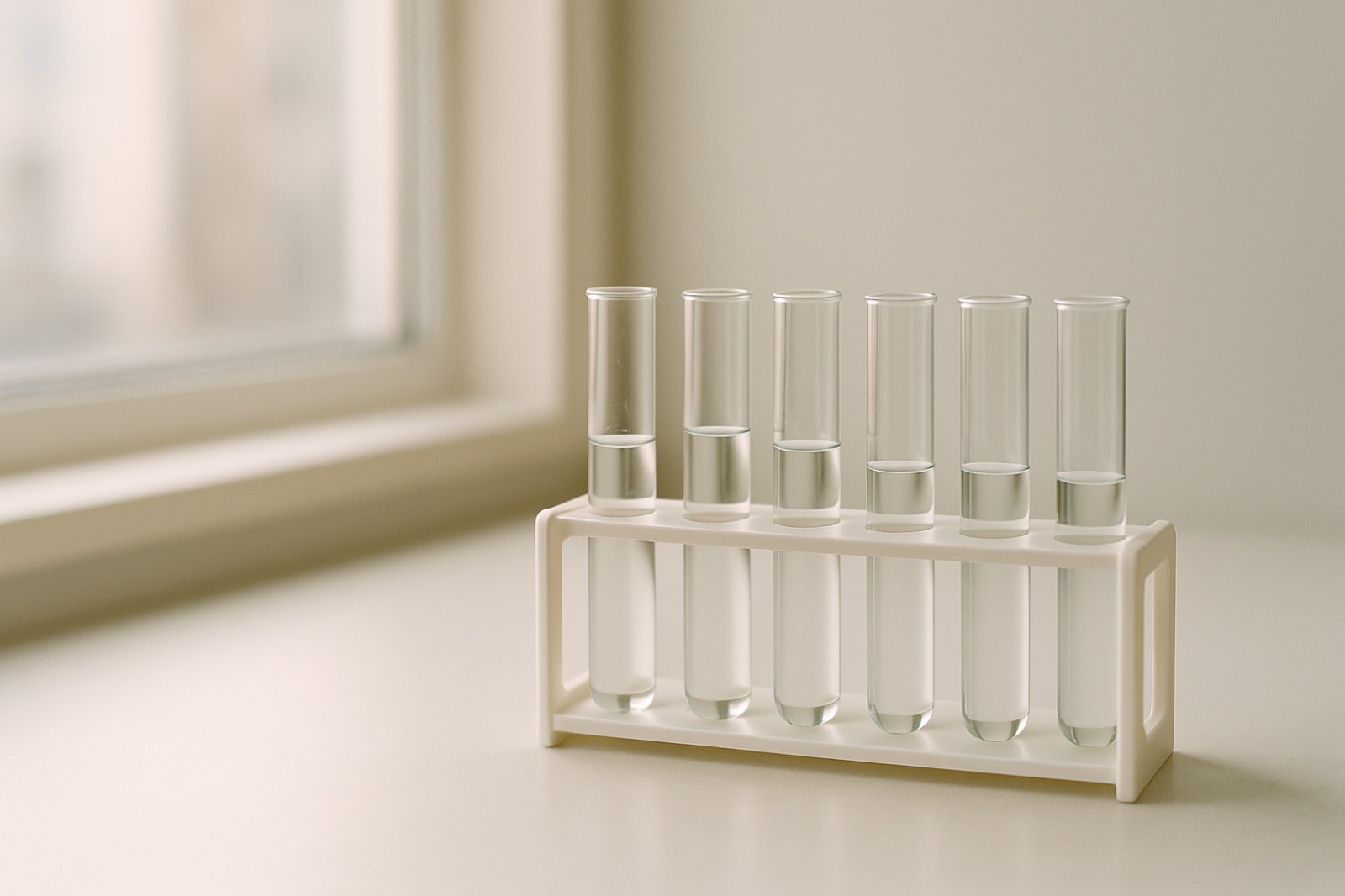
Water quality becomes easier to misread when every symptom is treated as evidence of contamination. White deposits, stiff laundry and soap that will not lather can indicate hardness. They do not establish that drinking water contains a contaminant at a concerning concentration. Clear, pleasant water can also contain constituents that cannot be detected by sight, taste or smell.
The distinction is increasingly relevant as water use and water measurement receive wider attention. On Sept. 14, 2026, The Guardian reported that Texas Gov. Greg Abbott directed regulators to penalize data centers that do not comply with state water-use disclosure laws. The report on water-use disclosure, by Maya Yang, concerns large facilities rather than homes. The transferable lesson is narrower: a visible effect or general impression is not a substitute for a defined measurement.
First, classify the evidence
Begin with what the household can observe. Chalky deposits on faucets, spotting on glassware, reduced soap performance and recurring scale in water-heating equipment belong in the hardness column. Hardness is primarily an operational and aesthetic issue involving dissolved calcium and magnesium. It can affect cleaning efficiency, fixtures and equipment without serving as a general measure of drinking-water safety.
Place orange or brown staining, metallic taste and dark deposits in a separate mineral and corrosion column. Iron and manganese can produce noticeable staining at concentrations that prompt aesthetic complaints. Metallic taste or blue-green staining may also justify investigation of plumbing materials and corrosive conditions. Appearance alone cannot identify the responsible constituent.
A third column is reserved for contamination concerns. These include a laboratory result above an applicable benchmark, a formal notice from the water supplier, a private-well vulnerability, or a specific event that could have affected the source or plumbing. Sudden unexplained changes deserve attention, but odor, color and taste still cannot prove that water is safe or unsafe.
Choose a test that answers the question
A hardness complaint calls for hardness data. A suspected iron problem calls for iron results. Concerns about lead, bacteria, nitrate or other regulated constituents require methods and sample handling appropriate to those analytes. A broad reading such as total dissolved solids cannot identify which dissolved substances are present, and it should not be treated as a contaminant screen.
Sampling location matters. A kitchen cold-water sample represents a different condition from hot water drawn through a heater. A sample collected after a treatment device cannot establish untreated source quality. For plumbing-related metals, flushing conditions and stagnation time can materially affect what the sample represents. Follow the laboratory's collection instructions rather than improvising a convenient bottle and sampling routine.
When the concern is not resolved by supplier information or a narrowly selected field measurement, get local water professionally tested. The testing scope should reflect the water source, plumbing, observed problem and any known local risks. More analytes do not automatically produce a more useful answer.
Read each result in five parts
1. Analyte: Identify exactly what was measured. Hardness, alkalinity, pH and total dissolved solids describe different properties and are not interchangeable.
2. Concentration and unit: Compare numbers only when the units match. Milligrams per liter, micrograms per liter and grains per gallon cannot be compared without conversion.
3. Reporting limit: “Not detected” generally means the laboratory did not detect the analyte at or above its stated reporting limit. It does not mean absolute zero.
4. Benchmark: Determine whether the comparison value is a regulatory limit, a health-based advisory, an aesthetic guideline or an equipment specification. Those categories support different decisions. A result associated with staining or scale should not be described as a health exceedance unless an applicable health benchmark says so.
5. Sample context: Record the date, tap, hot or cold condition, treatment status and collection procedure. Without that context, a precise number may still answer the wrong question.
Match the response to the finding
If hardness is elevated and the complaint is scale, treatment discussions can focus on scale control, softening capacity, maintenance and sodium or discharge considerations. If a specific contaminant exceeds an applicable benchmark, the next step is confirmation, source assessment and treatment certified for that constituent. If results are within the relevant benchmarks but the complaint persists, investigate plumbing, fixtures, water heating, treatment-device maintenance and cleaning practices.
The practical rule is simple: appliance trouble and cleaning difficulty justify investigation, but they do not diagnose contamination. A useful report names the constituent, quantifies it, supplies the unit and reporting limit, identifies the comparison benchmark, and preserves the sampling context. Until those pieces align, the result is data, not yet a treatment decision.