Climate variability keeps source-water conditions in public discussion. The Guardian, in reporting by Sara Sneath and Oliver Milman on climate talks and El Niño, describes national leaders addressing climate effects ahead of the United Nations General Assembly. That story does not establish that conditions have changed at any particular home. It does reinforce a practical distinction for household water decisions: broad environmental concern is not a substitute for evidence collected at the tap.
For homeowners, the first evidence is often residue. It appears on a shower door, inside a kettle, around an aerator or on dark laundry. Residue can help identify a maintenance problem, but appearance alone cannot determine whether water is safe. A useful diagnostic begins by recording where the material forms, what conditions produce it and whether it can be reproduced.
Check whether evaporation creates the deposit
White or pale material that develops where water repeatedly dries is consistent with dissolved minerals remaining after evaporation. Calcium and magnesium are common contributors to hardness, although appearance does not identify either mineral or quantify hardness.
Inspect several evaporation points: the shower door, faucet base, pet bowl and drip tray of an appliance. A similar deposit across cold-water fixtures supports a whole-house water explanation. A deposit confined to one fixture may instead reflect local cleaning products, a deteriorating aerator or material released from that fixture.
Do not classify colored deposits the same way. Orange, black, blue-green or oily-looking material can have several possible sources, including plumbing corrosion, sediment, microbial growth or substances introduced after water leaves the tap. Color is a reason to investigate, not a contaminant identification.
Compare hot and cold water
Heat can make mineral accumulation more visible because water heaters and heating elements concentrate deposits at surfaces. If residue, noise or declining performance occurs mainly in the water heater, kettle or dishwasher, hardness may be contributing to an equipment problem even when cold water looks clear.
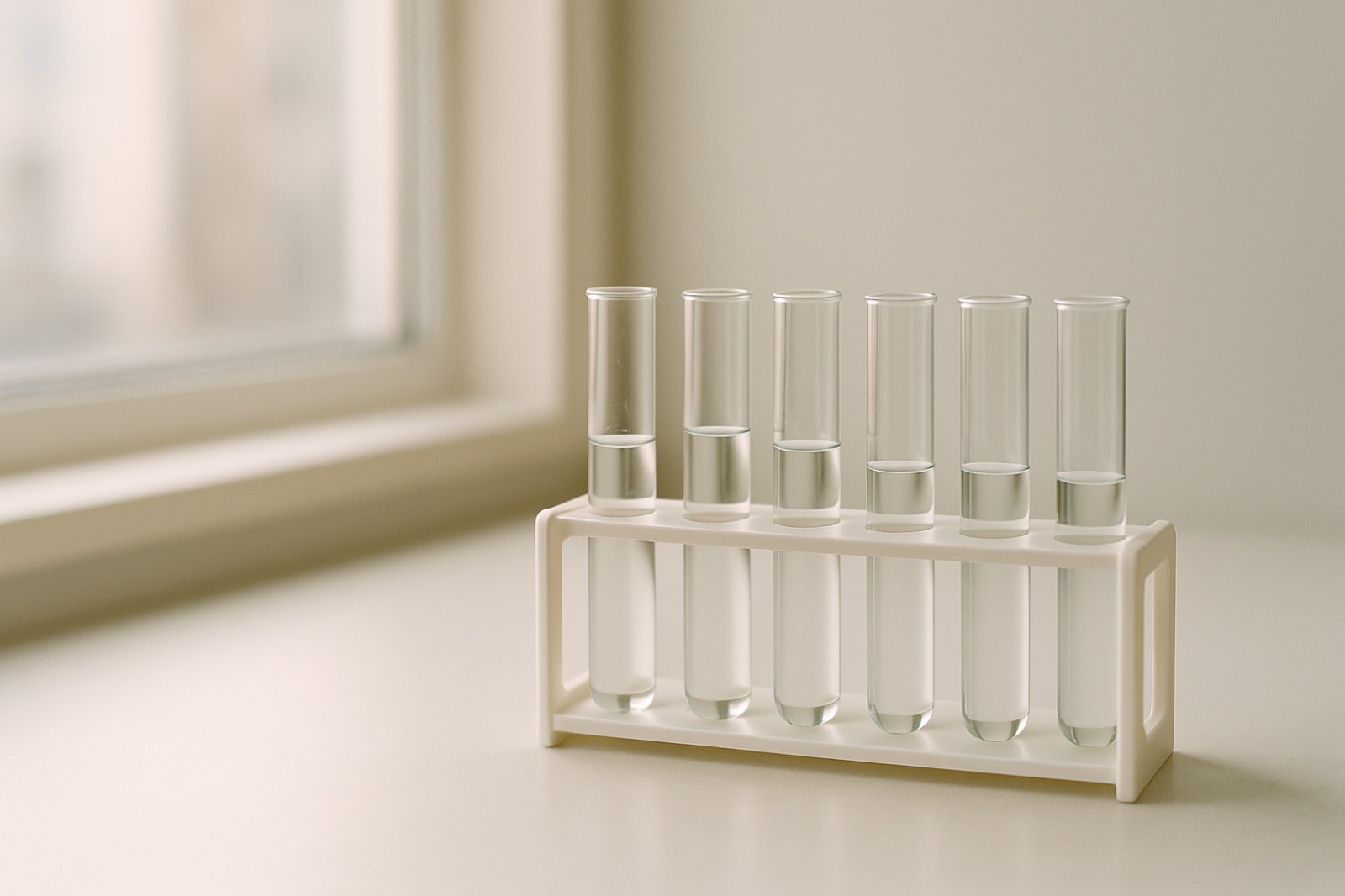
Run hot and cold water separately into clean, transparent containers. Note initial color, particles and odor, then observe the containers again after the water stands. A difference limited to hot water points toward the heater or hot-water plumbing. A difference present in both samples moves attention upstream, but it still does not establish whether the source is the service line, premise plumbing or supplied water.
Separate cleaning performance from contamination questions
Soap that lathers poorly, spotting on glassware and stiff-feeling laundry can be consistent with hard water. They can also be influenced by detergent dose, wash temperature, appliance condition and cleaning technique. Treat these signs as reasons to measure hardness, not as proof that treatment is required.
Skin or hair complaints are even less specific. Water chemistry may affect how soap rinses or how residue feels, but a household observation cannot establish a medical cause. Record whether the issue occurs at every fixture and whether it changes away from home. Keep any health evaluation separate from the water-equipment decision.
Know when observation has reached its limit
Testing becomes the appropriate next step when water changes suddenly, an odor persists, staining cannot be explained, particles repeatedly appear, a private well may have been affected by nearby activity, or a household needs to evaluate a specific contaminant. Testing is also necessary before selecting equipment intended to reduce a health-related contaminant. A hardness strip or dealer demonstration cannot answer that question.
Choose analytes from the water source and the concern. Hardness, iron, manganese, pH and total dissolved solids can help explain scale, staining or corrosion conditions. Microbial, nitrate, lead, arsenic or other contaminant testing requires suitable sampling methods and a qualified laboratory. The appropriate panel differs between a regulated public supply and a private well.
Homeowners who need laboratory selection or local sampling support can get local water professionally tested. Confirm the laboratory's methods, sample containers, preservation requirements and reporting limits before collecting water.
Read results as measurements, not verdicts
A hardness result describes mineral concentration and helps estimate scaling potential and treatment settings. It is not, by itself, a safety determination. A contaminant result should be read with its units, reporting limit, sample location and applicable benchmark. A non-detect means the laboratory did not measure the substance above its stated reporting limit. It does not mean the water contains absolutely none of it.
The practical sequence is straightforward: document the residue, compare locations, separate hot from cold, reproduce the observation and test when the question exceeds what household clues can answer. That process gives utilities, laboratories and treatment professionals a defined problem to investigate, while helping the homeowner avoid asking one symptom to answer two different questions.