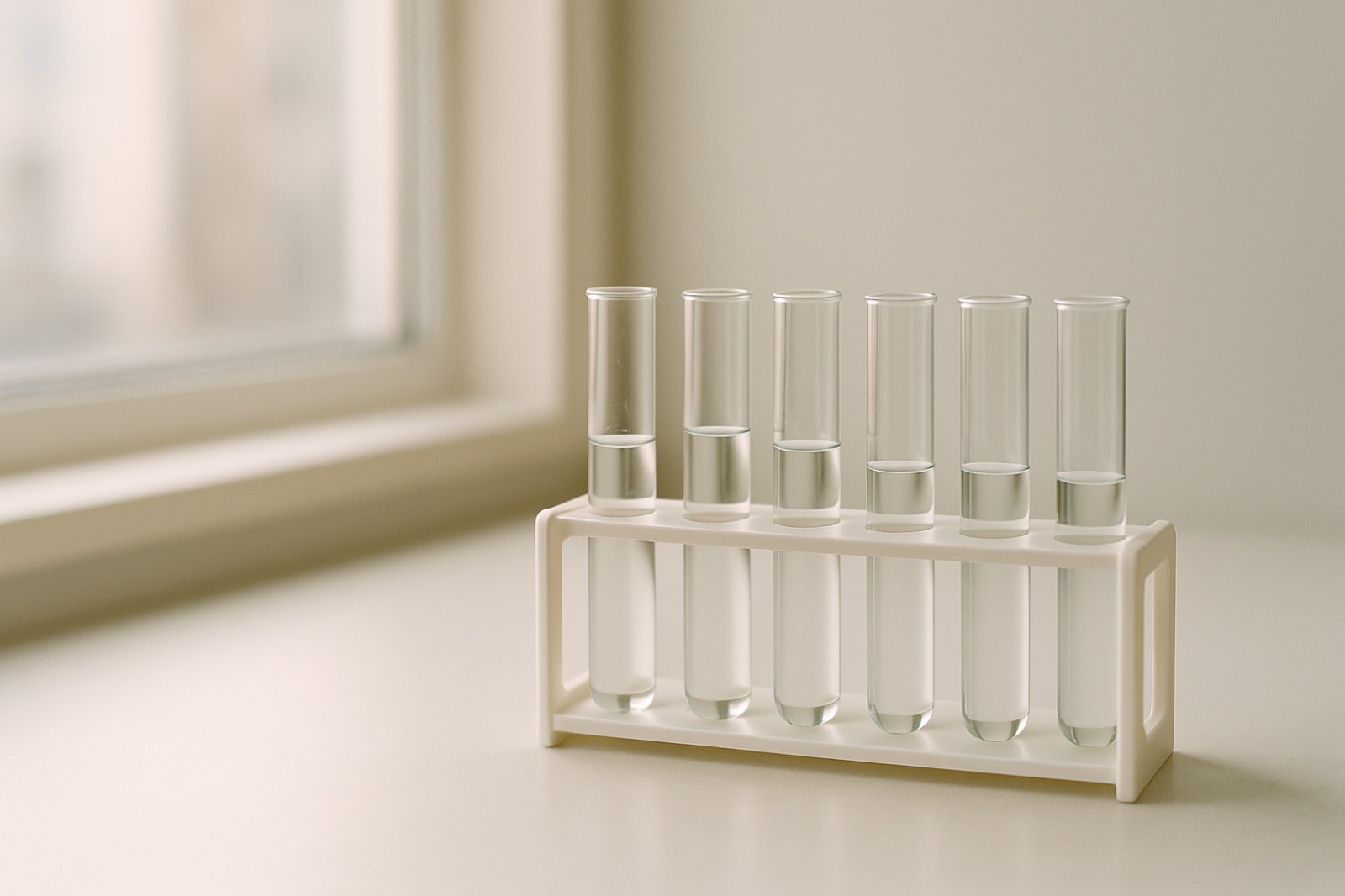
A white film on a faucet can justify a hardness test. It cannot establish that the water is contaminated. That distinction matters because hardness, corrosion, sediment and contaminants involve different mechanisms, different measurements and often different treatment equipment.
Source protection remains important upstream. Circle of Blue, in Keith Schneider's report on a Kansas prairie festival, describes agricultural work intended to protect soil, water and communities. Such practices address conditions across land and watersheds. A homeowner still needs household-specific evidence before attributing a stain, odor or appliance failure to source water.
Start with the residue pattern
Hard water contains dissolved calcium and magnesium. Heating or evaporation can leave some of those minerals behind. The resulting scale commonly accumulates where water dries repeatedly or encounters heat.
Inspect several locations before drawing a conclusion:
Faucet aerators and showerheads: A pale, crusty deposit concentrated around wet surfaces is consistent with mineral scale. It is a reason to measure hardness, not evidence of a hazardous contaminant.
Tea kettles, coffee equipment and water heaters: Deposits on heated surfaces strengthen the case for a scale problem. They also matter operationally because accumulated scale can interfere with heat transfer, flow or appliance maintenance.
Glassware and tile: Film that appears after water dries may reflect hardness, detergent performance, rinse settings or cleaning technique. If the film wipes away with an appropriate cleaner, that observation helps identify the mechanism but does not replace testing.
Only one fixture: A localized problem points toward that faucet, aerator, supply line or nearby plumbing. A source-water problem is more likely to appear at multiple cold-water taps, although plumbing materials and water age can modify what reaches each outlet.
Move contamination concerns onto a separate track
Many contaminants do not produce visible scale, taste or odor. Conversely, unpleasant appearance or smell does not identify a specific contaminant. The correct question is not whether the water seems bad. It is which analyte or water characteristic could explain the observation, and which test can measure it.
Use targeted testing when there is a defined reason, such as a change at multiple taps, a private-well vulnerability, a notice from the water supplier, known plumbing materials, nearby activity that creates a plausible pathway, or a need to verify treatment performance. Sudden changes in color, odor or turbidity should be documented with the affected taps, hot or cold setting, timing and duration before sampling.
Customers of a public water system can begin with the utility's water-quality information and ask whether the condition is occurring in the distribution system. Private-well owners generally carry more responsibility for selecting analytes and establishing a testing schedule. In either case, sampling instructions matter. A first-draw sample, a flushed sample and a sample collected after treatment answer different questions.
Read the result as a measurement
A hardness result is usually reported as milligrams per liter as calcium carbonate or in grains per gallon. It helps estimate scale potential and softener sizing. It does not determine whether unrelated contaminants are present.
A contaminant result should be read with four details: the analyte, concentration, unit and laboratory reporting limit. Then identify the comparison value that applies to the water source and purpose of the test. A nondetect generally means the laboratory did not measure the substance above its stated reporting threshold. It does not prove absolute absence.
Also check where and when the sample was collected. A result from an untreated basement tap cannot automatically describe water after a kitchen filter. A sample collected immediately after plumbing work may not represent normal operation. Results become more useful when the sampling point and operating conditions are recorded.
A practical decision checklist
Before selecting equipment, record whether the problem occurs at one tap or throughout the house, on hot water or cold water, continuously or intermittently. Photograph deposits before cleaning. Review appliance maintenance and detergent settings. Ask the utility about system conditions if the home receives public water. For a private well, document well work, flooding, land-use changes and treatment maintenance dates.
Next, match the test to the question. Order hardness and related mineral measurements for scale concerns. Select specific contaminant analyses only when a credible source, notice or pathway supports them. Homeowners who need help defining the sample point and analyte list can get local water professionally tested.
The useful dividing line is straightforward: residue patterns can support a hardness diagnosis, while contamination concerns require an appropriate sample and analyte-specific result. Keeping those investigations separate prevents a familiar household nuisance from being treated as proof of exposure, and prevents clear-looking water from being mistaken for complete evidence of quality.